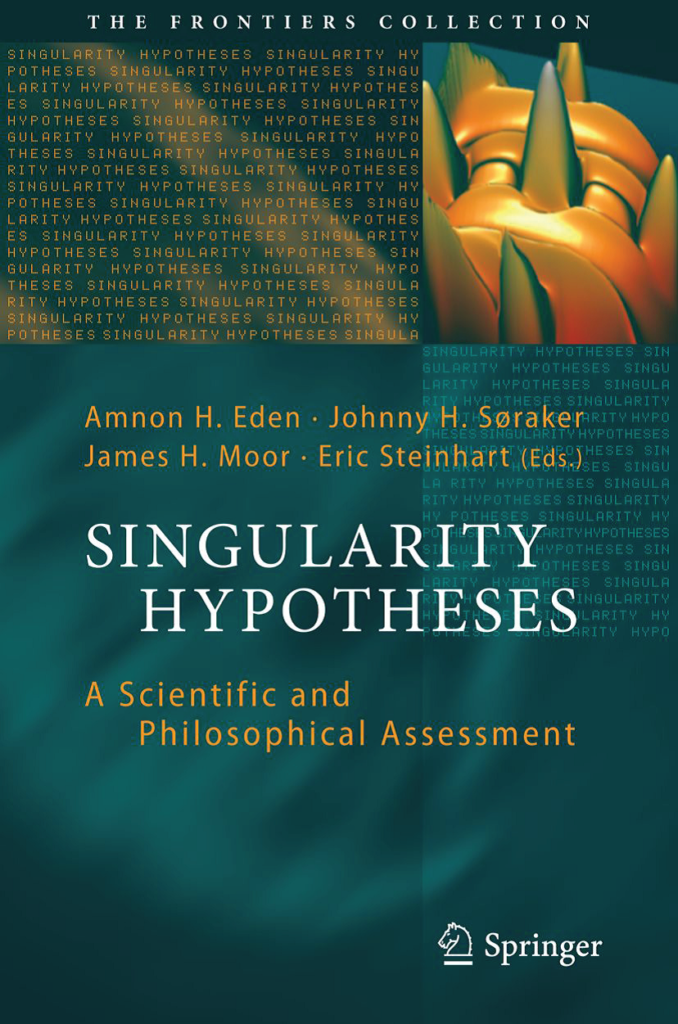
I edited the volume and, in the argument between skeptics and believers, I chose no sides. That was the right call in 2013. Thirteen years on, neutrality is no longer tenable — it is a dangerous evasion.
If what I say now seems to you to be very reasonable, then I will have failed completely. Only if what I tell you appears absolutely unbelievable, have we any chance of visualizing the future as it really will happen.
— Arthur C. Clarke1
Over a decade ago, having read Ray Kurzweil’s The Singularity Is Near, I studied the literature on artificial general intelligence (AGI) and developed close relationships with some of the key people in the field. David Chalmers’s seminal paper on accelerating AI2 crystallised the scenario philosophically and conceptually. Seeking to understand what exactly it means and what kind of a “breaking point in the history of human kind”3 it might be, I brought together the volume Singularity Hypotheses4. Written by leading researchers — with a rebuttal to each argument from the equally esteemed — the volume staged the debate over whether artificial intelligence will reach a ‘point of no return’ any time soon.
As the volume’s editor, I’ve remained strictly impartial — or rather strove to — by taking no position whatsoever in the debate. Whether human- and superhuman-level artificial intelligence (the most argued-for interpretation of the technological singularity) within 2–3 decades is realistic or fantastic, I felt it was my duty to remain agnostic. Today, this position is not only untenable but dangerous: remaining skeptical means remaining unprepared.
Consider the last decade: Large Language Models (LLMs) have displaced substantial elements of investment advisers, computer programmers, psychologists, college students, digital artists, and much of Hollywood’s technical industry, and have become the subject of genuine romantic entanglements5. And in the whirlwind of changes, Turing’s test is forgotten. Not only are we seduced to believe that everything ChatGPT tells us with great confidence could be written by a human — we need to be constantly reminded that AI is not an expert. That many of the images we see and videos we watch are entirely fictional. Social networks are awash with manufactured material that to many is indistinguishable from genuine news reports. It’s so hard to tell the difference that we’re at real risk of it polluting our records of the past.
AGI is around the corner. And we’re clearly unprepared for it.
We don’t have an AGI yet, and LLMs are far from being the last word about AI. But LLMs already outperform experts in a growing list of sciences and produce new results at the frontiers of mathematical theories6. We also struggle to understand how LLMs operate in precise terms and justify their decisions: while underpinned by mathematical principles, LLMs are black boxes trained on more data than any human in their lifetime could possibly absorb. Most critically, the list of “intelligence” tests where humans defeat machines is becoming shorter by the day. AGI is around the corner. And we’re clearly unprepared for it.
#ArtificialIntelligence #AIGovernance #Foresight
Every word here is my own; AI served only as copy-editor.
Dr Amnon H. Eden is a computer scientist, the Principal Scientist at the Sapience.org thinktank, and founder of Moneta Sapiens Ltd.
–» dysclaimer «–
Notes
- Horizon, BBC, 21 September 1964. Link
- David J. Chalmers, “The Singularity: A Philosophical Analysis”, Journal of Consciousness Studies 17(9–10), 2010, pp. 7–65. Link
- Ray Kurzweil, The Singularity Is Near: When Humans Transcend Biology. Viking, 2005.
- Eden, A. H., Søraker, J. H., Moor, J. H. & Steinhart, E. (eds.), Singularity Hypotheses: A Scientific and Philosophical Assessment. The Frontiers Collection, Springer, 2013. Link
- r/InLoveWithAI, Reddit. Link
- “The AI Revolution in Math Has Arrived”, Quanta Magazine, 13 April 2026. Link